

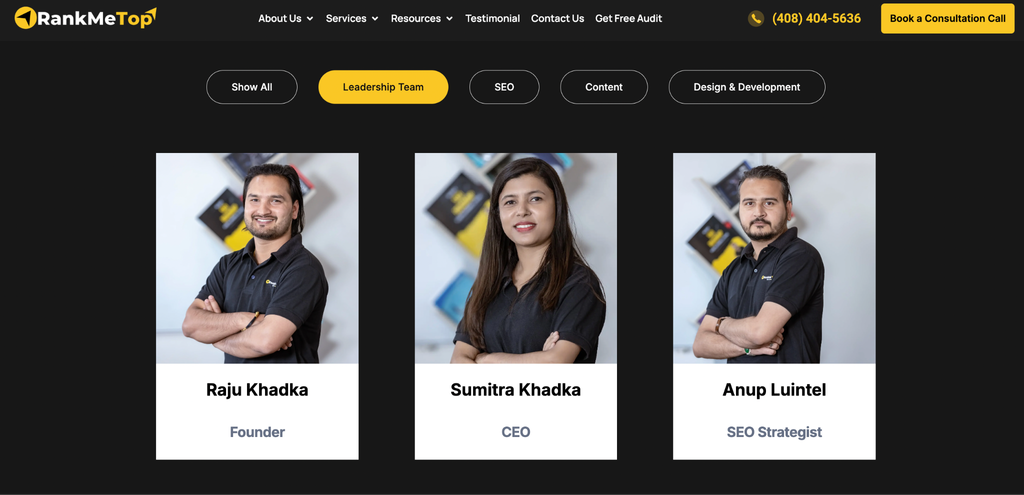
I am Anup Luintel. I am an Electronics and Communication engineer and I work as an Senior SEO strategist being on the Leadership Panel at RankMeTop, a Nepal Based US serving Plumbing and HVAC Marketing Agency.
That is the clean version. The more useful version is this: I spent 5+ years doing SEO across 200+ projects, 150+ live sites, 50+ niches, and clients in 9 countries before I built a public record under my own name. Yes, that is a strange opening for a person who works in SEO.
If you are an SEO consultant, you already know the joke here: I helped other people get found while making myself almost invisible. There is probably a support group for this, but we are calling it a website for now.
Most of my work lived inside client accounts, internal SOPs, private tools, Google Sheets, WordPress dashboards, and folders nobody outside the team would ever see. The results were real. The public record under my own name was thin, but the work had already started showing up in how other practitioners researched and executed SEO.
So this page is the correction. Not a polished guru bio. Not the “I am passionate about growth” paragraph that should be deleted from the internet for public safety. This is the plain version of who I am, what I build, how I think, and why my SEO work looks different from the usual checklist parade.
The Short Version
I do not treat SEO as a list of tasks. I treat it as a system with inputs, checks, decisions, outputs, and feedback loops.
The fuller identity has four parts: operator, engineer, researcher, and teacher. Client outcomes show the operating, tools show the engineering, collaborative studies show the research, and public credits from other practitioners show the teaching.
That habit comes from engineering. I earned a Bachelor of Engineering in Electronics and Communication Engineering from Thapathali Campus, Tribhuvan University, after starting the program in 2017. SEO pulled me sideways during those years because the local digital market had client demand, messy websites, and almost none of the tooling larger markets took for granted.
When a process did not exist, I built one. When a spreadsheet got repeated enough times, I turned it into a template. When a template was still wasted time, I turned it into a script, a WordPress plugin, a GPT, or an agent.
That is the real shape of my career so far: engineer falls into SEO, gets annoyed by manual repetition, then builds the workflow he wanted someone else to hand him. Slightly dramatic, but accurate enough to pass the audit.
The Work I Do
My specialty is entity-based SEO. In simple terms, I help a site make clear what it is, who it serves, where it operates, which topics it owns, and how every page supports that picture.
A local IT company in Houston is not just targeting a keyword. It is connecting at least two entities: the business category, “IT company,” and the location, “Houston.” If the homepage says one thing, the service pages say another, the internal links say nothing, and the schema quietly shrugs in the corner, Google has no clean reason to trust the whole picture.
That is where I spend a lot of time. I make those signals move together: page map, topical map, internal links, content structure, schema, technical crawl data, and local profile signals.
The visible output might be a page, a content plan, an audit, or a ranking gain. The work underneath is always the same question: what does this site need to prove, and where does that proof live?
The Proof Stack
The strongest number in my portfolio is 1.47B Google Search Console impressions on one anonymized YMYL and medical site. That corpus had about 130,000 pages, 21.2M clicks, an average position of 7.3, and a 16-month measurement window.
That case matters because the work operated at corpus scale in a YMYL and medical vertical. The recorded method included named-author credentials, answer-span optimization, topical clustering, sequential audits, and prior-plan reconciliation. The result came from a system applied across about 130,000 pages, not from one isolated URL.
Across my wider work, the working numbers are 5+ years, 200+ projects, 150+ live sites, 50+ niches, and 9 countries. Those projects include local businesses, ecom stores, B2B and SaaS sites, medical publishers, and service businesses.
I also conducted two collaborative research studies with Kedar Dangal in July 2024. Cognitive Search and Its SEO Implications covered NLP, machine learning, knowledge graphs, entity recognition, contextual analysis, and their SEO implications. Understanding Query Processing mapped the path from query understanding and rewriting through expansion, retrieval, post-processing, and result generation.
One more proof point matters for how I think: I checked 37 claims while developing my own visual-semantics model, then rebuilt the supported relationships as a chain from query context to search activity, page decision, page function, visual component, content, and links. The exercise reinforced one rule I use across my work: repeated language is not evidence, and a useful model must connect its source, mechanism, application, and verification.
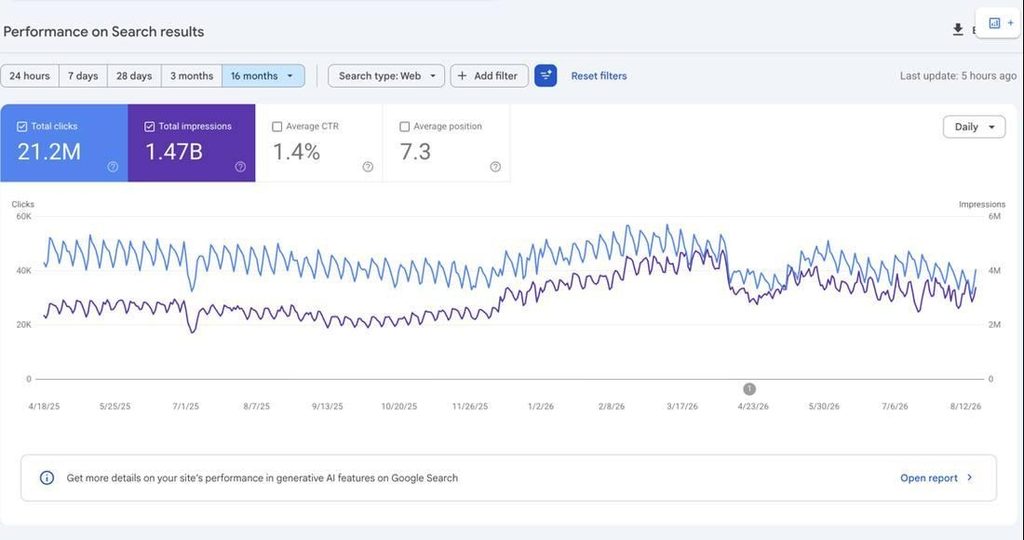
Recent update: A large-scale 301 consolidation was recently executed across a directory, part of a deliberate query-and-page consolidation strategy responding to today’s zero-click SERP environment and protecting the site’s threshold value. It produced a minor, expected dip that is already recovering, with the trajectory pointing to new highs beyond the prior peak.
Credit Where My Framework Began
I did not build this way of thinking in isolation. I began using this framework after Koray Tuğberk GÜBÜR discussed and explained it through his YouTube channel, the case studies and guides on Holistic SEO, and his published Oncrawl articles.
Those resources changed how I understood semantic SEO, topical authority, entities, context, and the mechanics behind search. I started using the framework in my own projects after learning those foundations from Koray, then kept testing it against different sites, business models, and implementation constraints.
Koray also pointed readers toward the work of the late Bill Slawski. I followed Bill’s search-patent analysis through SEO by the Sea and his Search Engine Journal articles, which strengthened my habit of reading closer to the source instead of relying only on market summaries.
At a later stage, RankMeTop founder Raju Khadka bought the course for me so I could access the full material. I have probably worked through it more than ten times. That may sound excessive, but apparently my idea of revision is to keep going until the framework starts appearing in tools, audits, and folder structures.
The credit matters because learning has a lineage. Koray explained the foundation, Bill’s work deepened the patent-reading habit, and Raju invested in giving me deeper access. My part came after that: applying the ideas across real projects, testing where they held or broke, adapting them to service and ecom workflows, building tools around repeated decisions, and teaching the reasoning to other practitioners.
When the Work Started Showing Up in Other People’s Thinking
The part I understated was not another traffic number. It was evidence that the method could leave my own laptop, make sense to another practitioner, and change how that person approached the work. That is the point numbers alone cannot show.
Dil Bahadur B.K. published a breakdown of three Google patents about query augmentation and result selection. In his post, he credited me with introducing him to semantic SEO, Google patents, and how search works beneath the visible results. He described me as a patient teacher, which means more to me than another software badge in a bio.
Yugesh Baral has made the same influence visible across several parts of SEO. In one local SEO post, he said my thinking on topical authority, topical relevance, and local SEO strategy shaped how he builds websites that search engines can understand and trust.
In a second site-structure post, Yugesh credited my influence on how he builds content ecosystems instead of isolated pages. In his article on NLP, query parsing, and information retrieval, he credited the insights and inspiration behind the research to me.
The Reddit case needs precise attribution. Yugesh found the opportunity, wrote the thread, managed the discussion, and owns the result: 400,000+ views, a 400% rise in branded search, and growth from 4 to more than 30 organic leads a month. In the public post connected to his full case study, he said I was the reason Reddit was on his radar and called the play my influence.
Their work is theirs. The reason these credits belong on this page is not to collect ownership over somebody else’s output. They show that my method can be explained, questioned, carried into a different problem, and used without me standing over every decision.
That is a different kind of proof from impressions, repositories, or shipped software. It shows capability transfer. A system becomes more valuable when another smart person can understand the reasoning and produce work of their own with it.
The Systems I Built
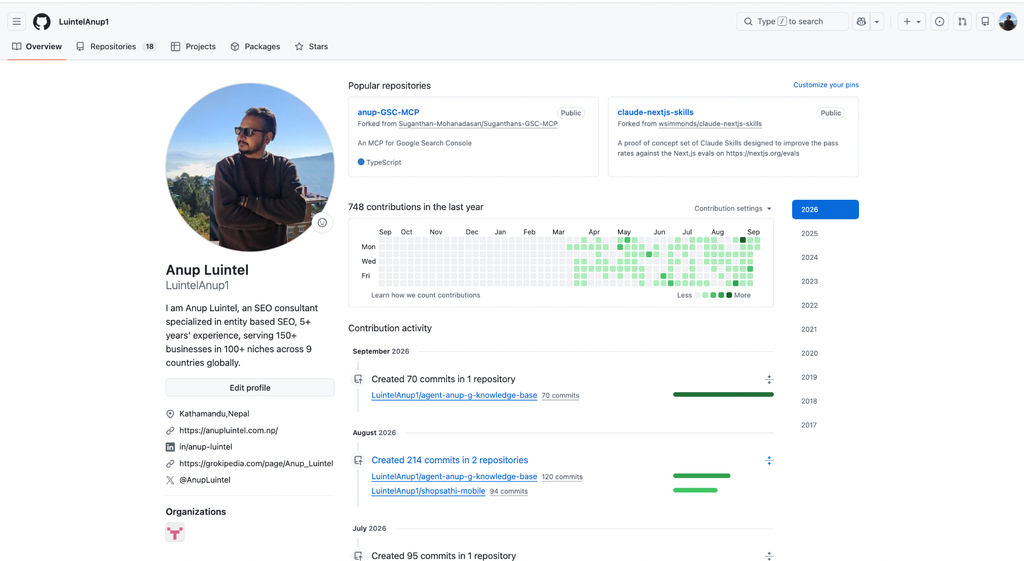
The private builder stack is the part most people never saw. It includes 18 GitHub repos with roughly 43,000 lines of code, 6 WordPress plugins, 8+ Google Apps Scripts, 8 Colab notebooks, 9 custom GPTs, 21 Agentic skills, 2 bookmarklets, a Chrome extension, N8N workflows, a Slack coworker bot, and 5 larger local applications described below.
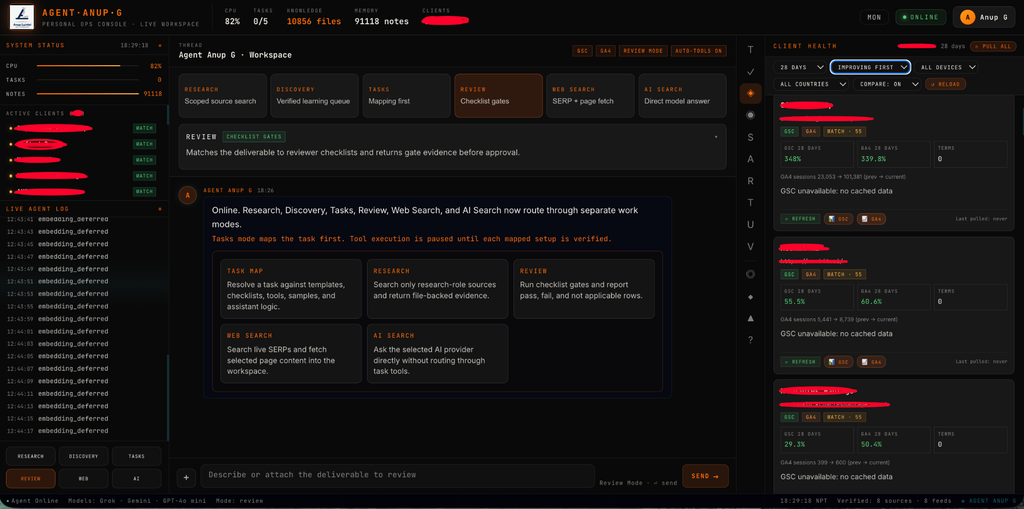
The flagship project is agent-anup-g. It is a local SEO agent fleet built around cost-ordered LLM routing, which means the cheapest model capable of doing a task gets the work before a more expensive model is called.
The Streamlit and Local Apps
The tool inventory is not just scripts and WordPress plugins. Six local applications carry larger parts of the workflow from raw inputs to usable plans, audits, briefs, or tracking data.
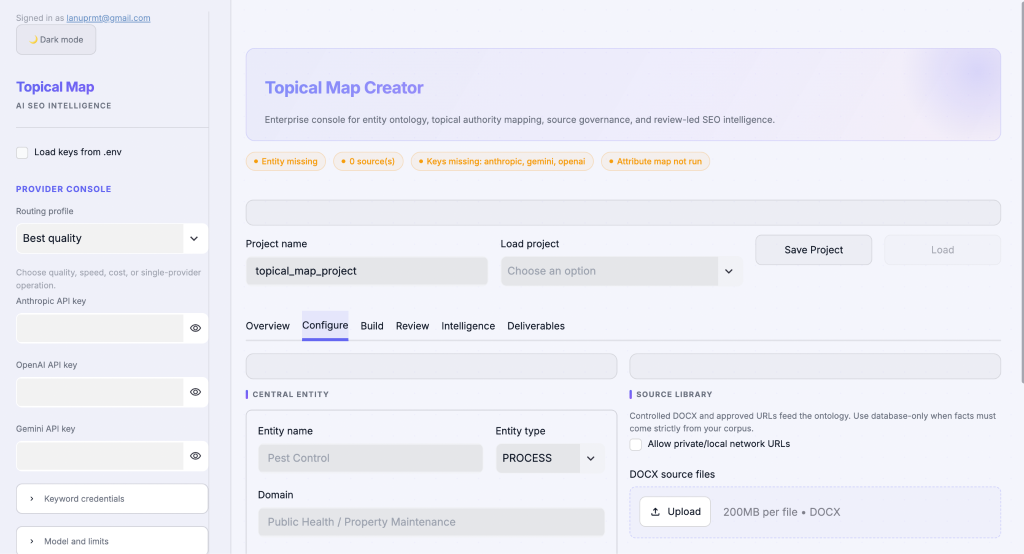
Topical Map Creator is a Streamlit app that reads approved documents and URLs, builds an entity ontology with salience layers, adds optional keyword data, and exports XLSX, HTML, and JSON.
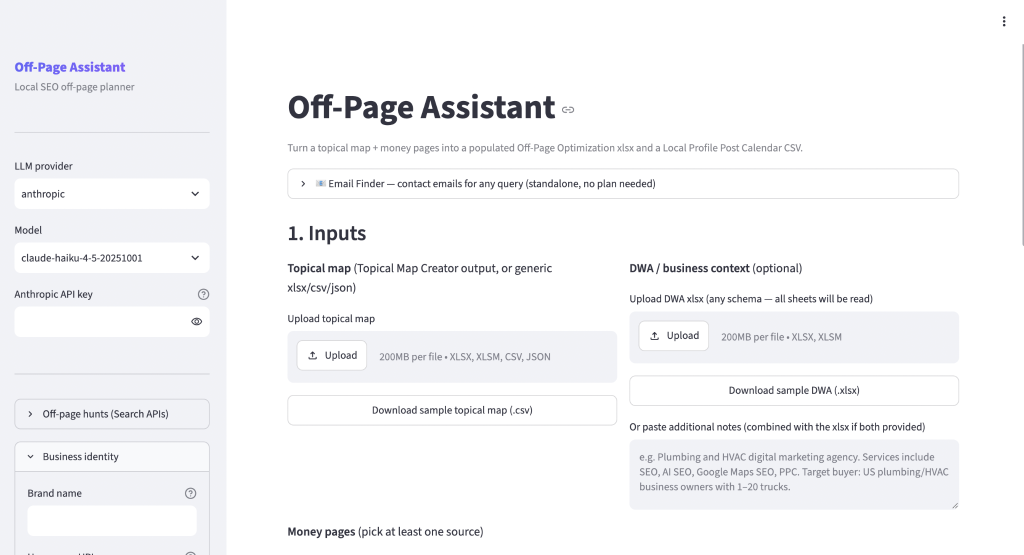
Off-Page Assistant is a Streamlit app that turns a topical map, money-page list, and domain-wide analysis into a 14-sheet off-page workbook plus platform policy packs.
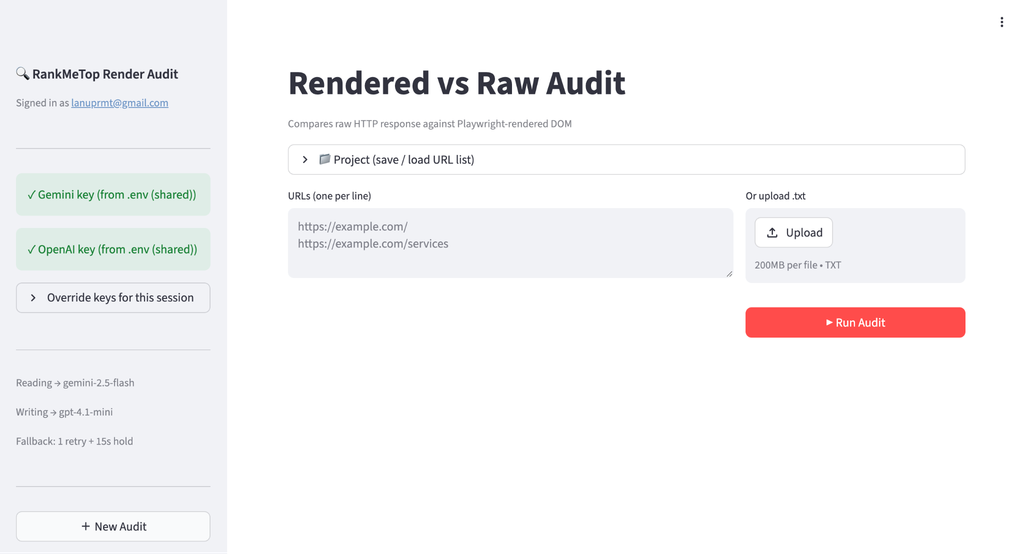
Render Audit Tool is a Streamlit app that compares raw HTTP responses with Playwright-rendered pages, identifies signals that search and AI crawlers may miss, and exports XLSX, HTML, and JSON reports.
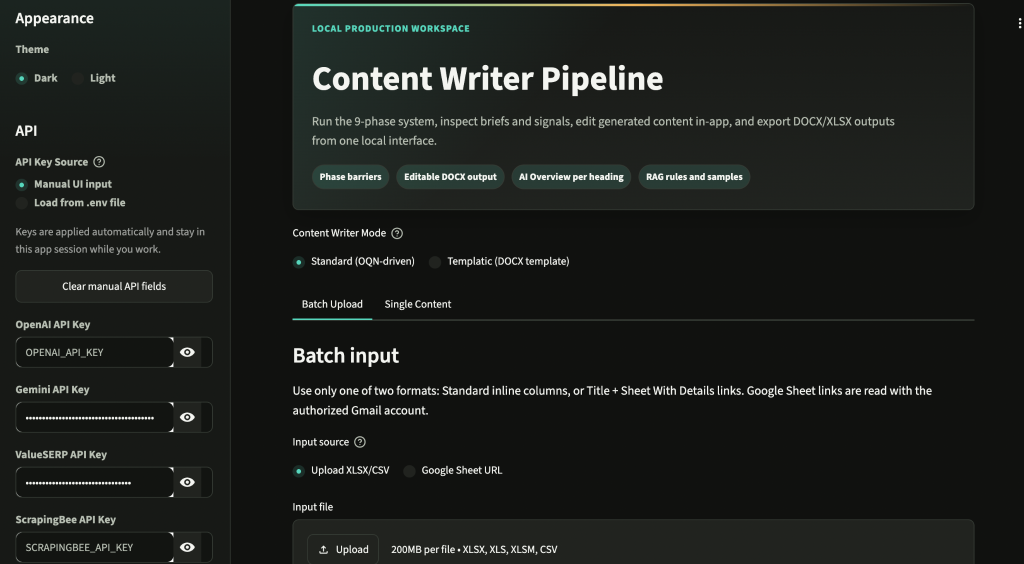
Content Writer is a Streamlit app with a 10-phase pipeline for competitor research, linguistic extraction, query filtering, semantic outlines, fact checks, briefs, section writing, and DOCX or XLSX export.
Commercial Content Writer runs through Streamlit locally and through a private cloud setup. It builds commercial pages with evidence checks, content obligations, review gates, and project-specific inputs instead of treating every page like a blog post.
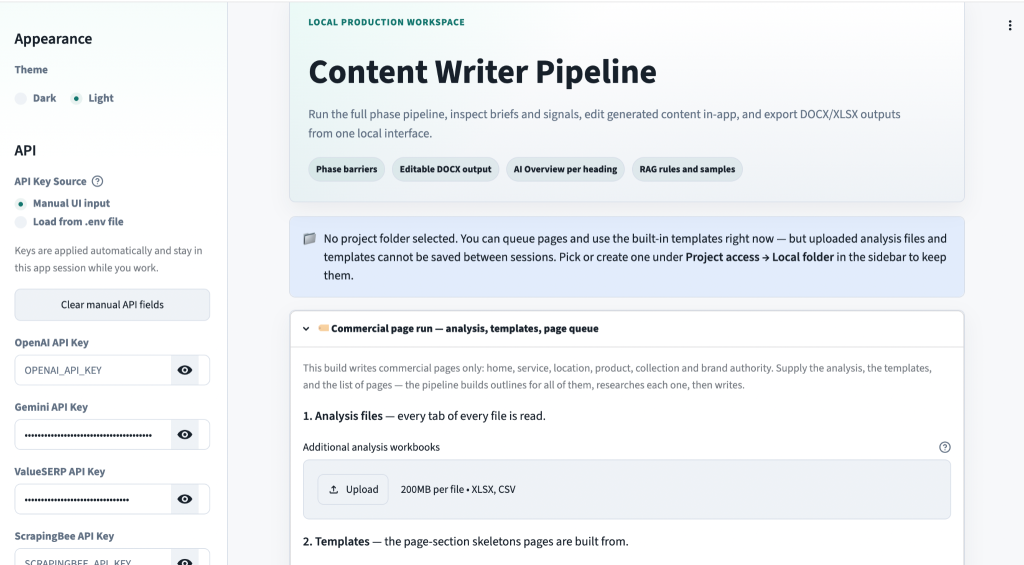
The point is not that these tools have interfaces. Each one turns a repeated judgment into a visible process with inputs, outputs, and checks. That is the same engineering habit behind the frameworks, only running as software.
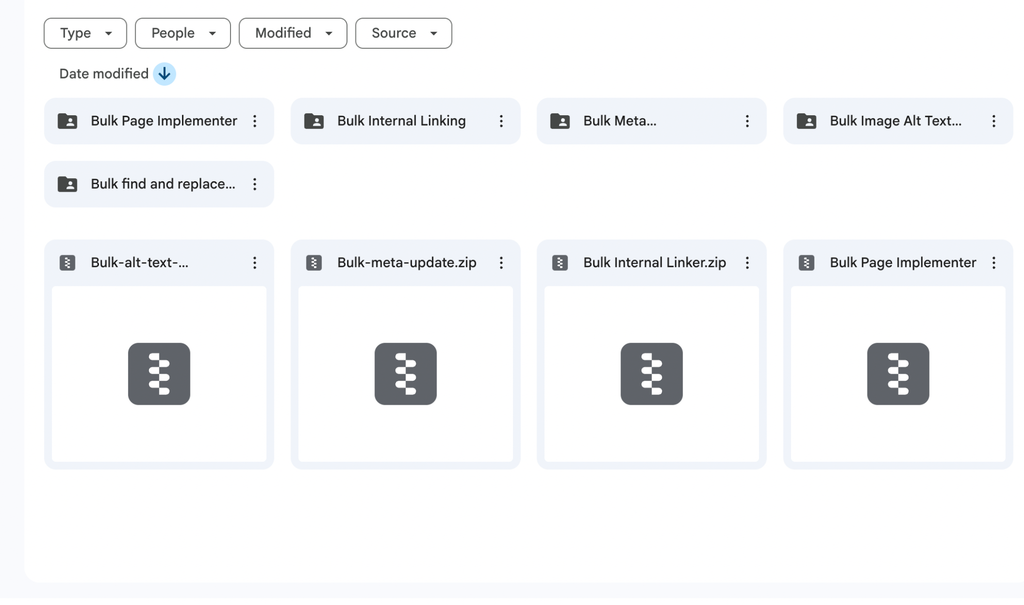
The six WordPress plugins solve recurring delivery problems. Each one exists because the same task kept showing up inside real client work.
- Bulk Page Implementer handles page creation at scale.
- Bulk Meta Update handles title and meta changes.
- Bulk Internal Linker handles link insertion.
- Bulk Alt Text handles image text.
- Elementor Find-Replace Links handles migration cleanup.
- Duplicate Pages handles cleanup after bulk implementation.
The Google Apps Scripts solve the annoying spreadsheet problems that show up every week. Meta and H1 extraction, title and meta generation, alt text generation, slug stripping, canonical checking, and redirect planning all became scripts because doing them by hand more than twice felt like losing a bet to my past self.
The GPT stack is not one prompt with a fancy name. It is a pipeline: topical map, semantic outline, content brief, advanced content writer, contextual internal linker, and supporting checks around them.
I also built ShopSathi, a Nepali-first mobile POS and inventory app for a real kirana shop. It is not an SEO tool. It is a shipped product with offline-first sync, Supabase Row-Level Security, Cloudflare R2 image storage, event-sourced stock changes, and 384 tests passing at last count.
ShopSathi matters because it proves the engineering part is not branding makeup. I can build outside SEO when the problem deserves a product instead of another spreadsheet.
How I Think About SEO
I do not start with keywords. I start with the business, the entities around it, the page types it needs, and the evidence Google would need before trusting those pages.
A keyword can tell you there is demand. It cannot tell you whether a separate page should exist, whether that page belongs under a service hub, whether it needs a local modifier, or whether the site already has enough authority to support it.
I see two market habits repeatedly. Parrot reading turns a repeated claim into borrowed certainty, while the market sheep parade turns popularity into a substitute for testing.
My answer is simple: inspect the source, define the mechanism, apply it to a real page decision, and check the output. If the reasoning cannot survive those four steps, I do not turn it into a framework for client work.
That is why my workflow has gates. Each gate answers one decision before the next part of the work starts.
- QDP decides whether a candidate deserves its own URL.
- Centerpiece annotation decides the main job of an approved page.
- The topical map decides how the page connects to the rest of the site.
- The content system decides what must be answered, proved, linked, marked up, and reviewed before the page ships.
If that sounds too structured, good. Random content calendars are how teams end up with 80 pages nobody can explain six months later. Structure is how the page earns its place before a writer starts typing.
Who This Is For
I write for agency owners running 20+ accounts, SaaS founders with a growing content stack, SEO consultants who want frameworks instead of templates, and in-house SEO leads who need cleaner systems. Those people need repeatable decisions, not a new brainstorm every Monday.
If you want “10 quick SEO tips,” this will be painful in the healthiest possible way. I am not writing that kind of content.
If you want to see how SEO work gets decomposed into decisions, artifacts, tools, and feedback loops, you are in the right place. Bring coffee, because some of the naming gets intense.
Why I Am Publishing Now
For five years, referral trust did most of the work. Another consultant, founder, or team member knew what I could do, and that trust moved quietly from one project to another.
That works, but it does not teach anyone. It also leaves the strongest part of the work hidden: the method.
So I am publishing the system in public. The frameworks, the tools, the case studies, the mistakes, the weird internal names, the places where the process broke, and the fixes that survived real projects. That is what this 63-topic run is built to unpack.
The next post explains the workflow model behind my service and ecom projects. It covers five connected views of the work, six recurring execution cycles, and the different routes taken by a new site, an existing site, a migrating domain, or an acquired domain.
The model starts before foundational setup, continues through live implementation, and keeps running after launch through audits, tracking, content, authority, and review loops. Day 3 is next, and that is where the system stops being a claim and becomes a map.